
A Maui surf lesson for beginners is one of the easiest ways to experience surfing without trying to figure out the ocean, equipment and technique on your own. Beginner lessons typically combine basic instruction on land with supervised practice in the water, helping first-time surfers understand paddling, board control, standing up and basic ocean awareness.
The best lesson depends on more than price. Your swimming ability, age, group size, where you are staying, current ocean conditions and how you plan to spend the rest of the day all matter.
If you are staying in Kihei, Wailea or elsewhere in South Maui, it also helps to think about transportation separately: how you will reach your lesson may be different from how you explore South Maui afterward.
Maui Surf Lessons for Beginners at a Glance
| Question | Quick Answer |
|---|---|
| Are there beginner surf lessons on Maui? | Yes. Maui has lessons specifically designed for first-time and beginner surfers. |
| Do you need your own surfboard? | Usually not. Many surf schools provide the necessary surf equipment, but confirm before booking. |
| Group or private lesson? | Group lessons suit many first-timers; private lessons provide more individual instruction. |
| Do you need to know how to swim? | Many operators require basic swimming ability or comfort in deeper water. Check the school’s requirements. |
| Where can beginners surf near Kihei? | The Cove at Cove Beach Park is a well-known beginner-oriented surfing area in Kihei. |
| Should you surf without checking conditions? | No. Ocean conditions change, so follow your instructor and current safety guidance. |
| Do you need a car for the whole day? | Not necessarily. Transportation to a lesson and local transportation afterward can be separate decisions. |
Are Maui Surf Lessons Good for Complete Beginners?
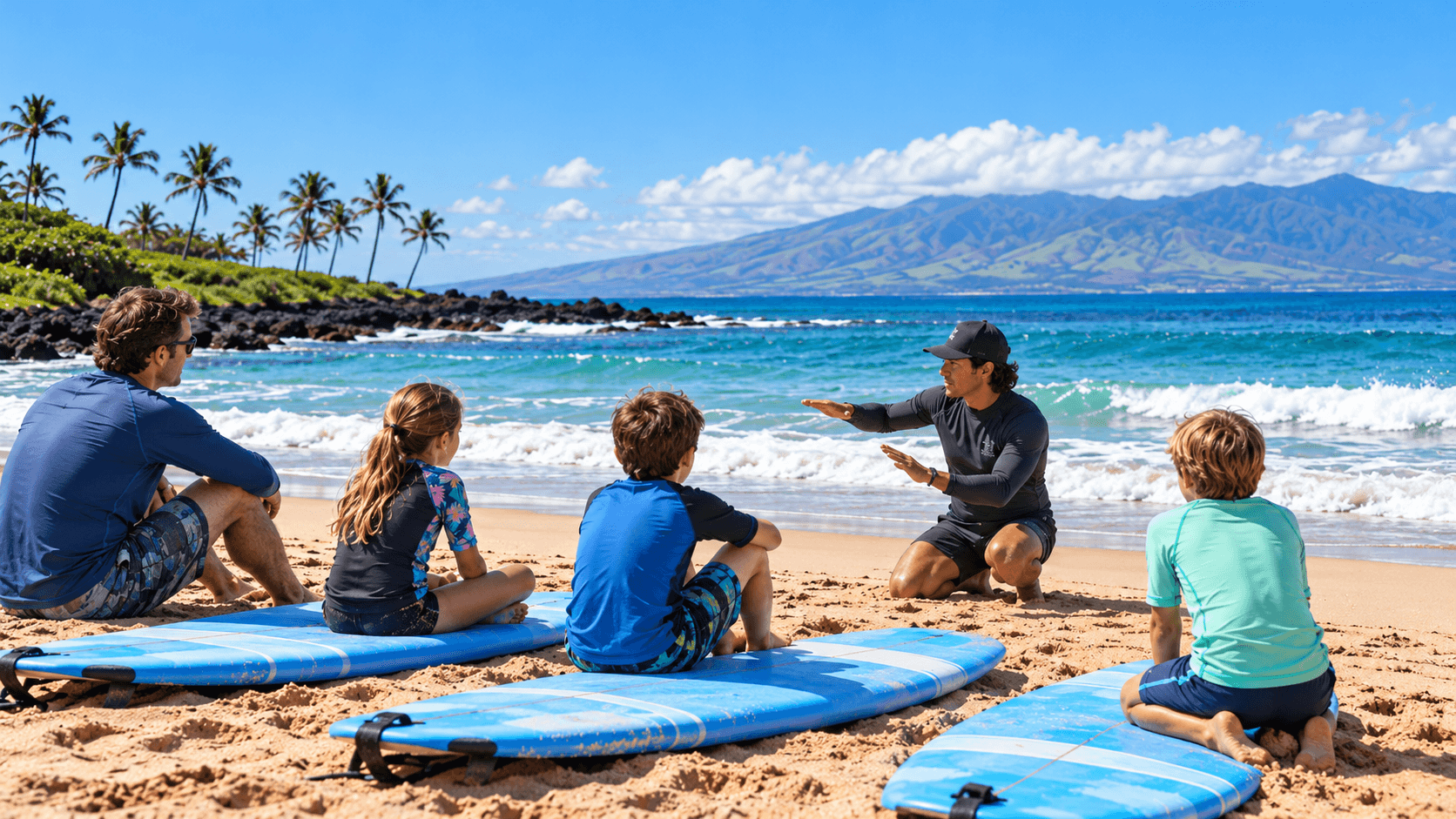
Yes. Many Maui surf schools offer lessons specifically for people who have never surfed before.
A beginner lesson is not about sending a first-time surfer into the water and hoping they figure it out. Instruction normally starts with the basics before participants begin practicing in the ocean.
You may learn about:
- how to position yourself on the board;
- basic paddling;
- how to move from lying down to standing;
- balance and stance;
- where to look while riding;
- how to handle the surfboard safely;
- basic surf etiquette;
- how to respond to the conditions at the lesson location.
Some local operators currently offer group, semi-private, private and family-oriented lesson formats, so beginners can choose different levels of individual instruction. Requirements can also differ by lesson type and age.
The goal should not be to guarantee that you will stand up on your first wave. A better goal is to leave the lesson understanding the fundamentals and feeling more comfortable with how surfing works.
What Happens During a Beginner Surf Lesson in Maui?
Every surf school has its own teaching process, but most beginner experiences follow a similar sequence.
Check-In and Equipment
You will normally meet the instructor, confirm your reservation and get the equipment required for the lesson.
Depending on the surf school, equipment may include:
- a beginner-friendly surfboard;
- a rash guard;
- reef or water footwear where appropriate;
- other lesson-specific gear.
Always check what your operator includes before leaving your hotel or condo.
Instruction on Land
Before entering the ocean, beginners usually spend some time learning the basic movements on the beach.
This is where you can practice:
- lying correctly on the board;
- paddling position;
- moving into a standing position;
- foot placement;
- maintaining balance;
- what to do if you fall.
It is much easier to understand these movements on land before adding waves.
Supervised Time in the Water
Once the instructor is satisfied that the group understands the basics, the lesson moves into the ocean.
The instructor can help identify appropriate waves, position the board and correct mistakes between attempts.
The exact amount of water time depends on the lesson format, surf conditions, participant ability and operator.
Group vs Private Maui Surf Lessons: Which Is Better?
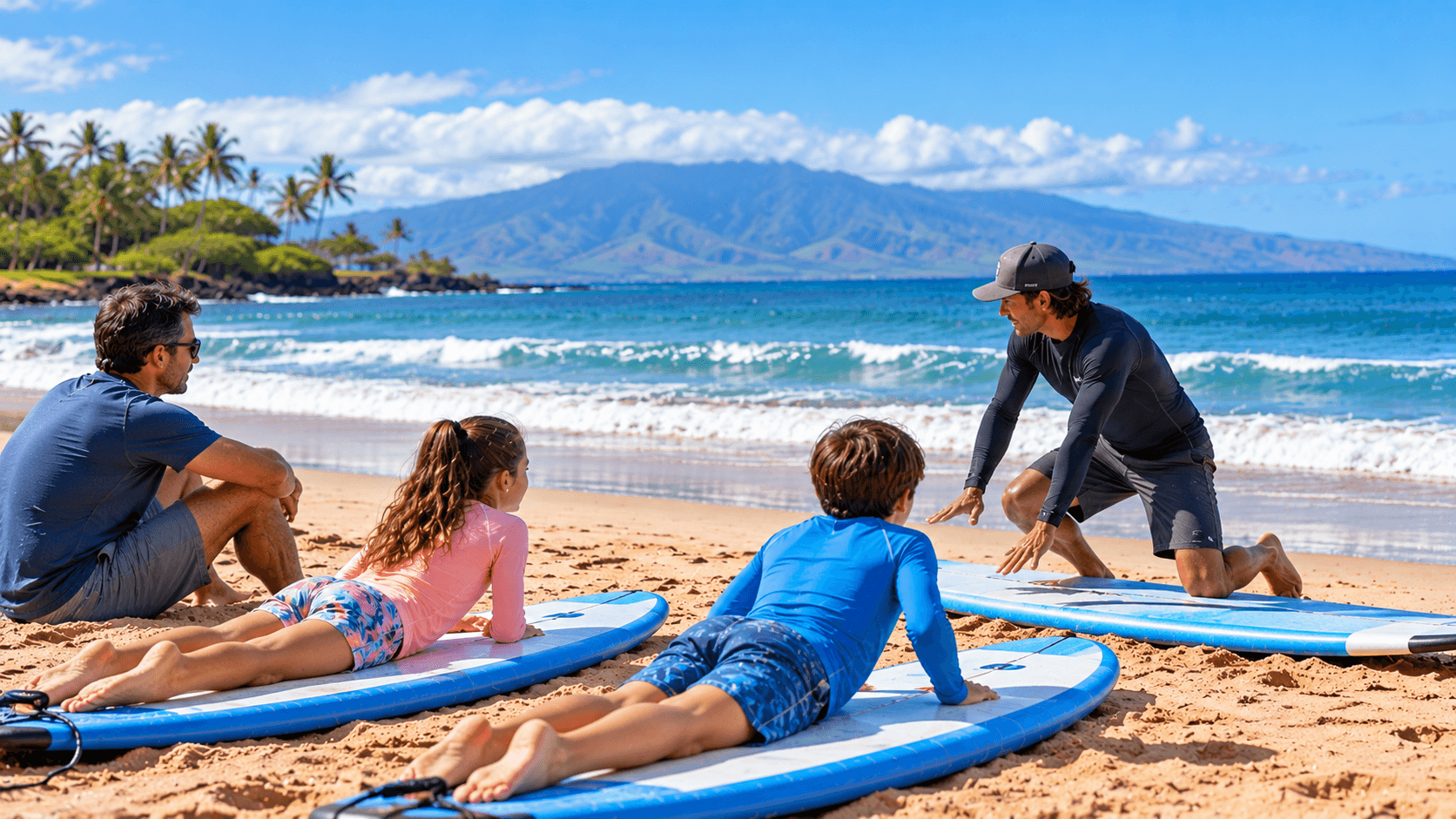
Neither format is automatically better. The right choice depends on how much individual attention you want.
| Lesson Type | May Be Best For | Main Consideration |
|---|---|---|
| Group lesson | Solo travelers, friends, adults comfortable learning with others | More shared instruction |
| Semi-private | Couples, friends or small families | Smaller group with more focused coaching |
| Private lesson | Nervous beginners or travelers wanting individual attention | Usually higher cost |
| Family lesson | Parents traveling with children | Instruction can be organized around different ages and abilities |
A group lesson can be perfectly suitable for a confident first-timer.
Private instruction may make more sense if you are nervous around the ocean, need additional assistance or simply want the instructor focused on your technique.
Parents should check the operator’s current minimum ages and lesson requirements rather than assuming children can join an adult group class.
Where Can Beginners Learn to Surf in Maui?
Surf lesson locations can vary because Maui’s ocean conditions are not the same everywhere or every day.
Two geographic areas are especially useful to understand if you are staying in South Maui.
The Cove and Kalama Park in Kihei
Cove Beach Park, next to Kalama Park in Kihei, is recognized by the County of Maui as a popular location for beginner-oriented surfing and stand-up paddleboarding. The Cove sits in the heart of Kihei, close to South Kihei Road, restaurants and other local activities.
That makes the area particularly relevant for visitors already staying in Kihei.
The County currently lists no lifeguard on duty at Cove Beach Park, which is another reason first-time visitors should not confuse “beginner-friendly” with “risk-free.” Follow your instructor and current ocean guidance rather than entering unfamiliar conditions based only on how the water looks.
Ukumehame and Areas Beyond South Maui
Some surf schools operate farther north between the Maalaea and West Maui areas.
For example, current surf-school information shows lessons taking place at Ukumehame Beach Park, with locations sometimes adjusted for waves, wind and weather.
This matters when planning transportation.
A traveler staying in Kihei might find a lesson at the Cove convenient for a South Maui day, while another surf school may require driving beyond Kihei toward a different part of the coast.
Always confirm your actual meeting location, not just the surf school’s business name or general service area.
What Should You Bring to a Maui Surf Lesson?
Your surf school should provide a specific checklist, but a little preparation can make the experience easier.
Consider bringing:
- water;
- a towel;
- reef-safe sun protection where appropriate;
- a change of dry clothes;
- a secure place for keys and valuables;
- your booking details;
- any required identification;
- footwear suitable for getting to and from the lesson area.
Do not assume every operator provides exactly the same equipment.
Ask whether your booking includes the board, rash guard and any footwear or other equipment needed during the lesson.
Do You Need to Know How to Swim Before Taking a Surf Lesson?
You should check the requirements of the specific surf school before booking.
Some operators require participants to be able to swim, while certain group lessons require students to be comfortable in water over their heads and capable of paddling independently.
Be realistic when answering questions about your ability.
A Maui vacation is not the right time to exaggerate your swimming experience just to qualify for a particular lesson.
If you are uncomfortable in deeper water, tell the surf school before booking. A different lesson format or activity may be more appropriate.
Is Surfing in Maui Safe for Beginners?
Surfing involves the ocean, so no surf location is completely predictable.
The most important mistake a beginner can make is assuming that a beach is safe simply because the water looks calm.
Hawaii Ocean Safety warns that conditions can change quickly and advises beachgoers to read posted warnings, check conditions and ask a lifeguard when one is available. Strong currents, shorebreak and high surf can create hazards that may not be obvious to a visitor.
Before Getting in the Water
For a beginner lesson:
- listen carefully to your instructor;
- follow the designated lesson area;
- check the day’s conditions;
- obey posted warnings;
- stay within your ability;
- tell the instructor if you are tired or uncomfortable;
- do not wander into a different surf area because the waves look more exciting.
Hawaii’s surf patterns also change throughout the year and by shoreline exposure. South, north, east and west-facing shores can experience very different conditions during the same season.
That is why a professional lesson should be based on current conditions, not just a famous beach name.
What Time of Day Is Best for a Beginner Surf Lesson?
You will often see morning surf lessons offered, but there is no single clock time that guarantees ideal beginner conditions every day.
Wind, swell direction, tide, weather and location all affect the ocean.
Hawaii Ocean Safety notes that wind activity often increases later in the morning or afternoon, but this should not be turned into a rule that “morning is always safe.”
The better approach is simple:
Choose a reputable lesson time and let the surf operator make condition-based decisions.
If your schedule allows, booking your lesson earlier in the trip can also give you more flexibility if weather or ocean conditions require a change.
How Much Do Maui Surf Lessons Cost?
The price of a Maui surf lesson can vary considerably.
Instead of comparing only the advertised number, look at what the booking actually includes.
Cost can depend on:
- group versus private instruction;
- lesson duration;
- number of participants;
- student-to-instructor ratio;
- participant age;
- equipment;
- photography packages;
- location;
- additional assistance requirements.
A cheaper lesson is not automatically better value if you want more personal instruction.
Likewise, a private lesson may not be necessary for every healthy, confident beginner.
Choose the format based on the experience you need.
What Should You Wear for a Maui Surf Lesson?
Follow the clothing guidance provided by the surf school.
For time in the water, wear something secure and comfortable that will stay in place while paddling, falling and climbing back onto the board.
Your operator may provide a rash guard.
Also bring dry, comfortable clothing for afterward.
That becomes especially useful if your surf lesson is only the first activity in a longer Maui day.
How Should You Get to Your Maui Surf Lesson?
This question is often overlooked.
The right transportation depends heavily on where the lesson actually takes place.
A lesson in Kihei creates a very different transportation plan from one near Ukumehame or farther toward West Maui.
Before deciding, check:
- the confirmed meeting point;
- how far it is from your accommodation;
- whether you will carry additional beach gear;
- what you plan to do afterward;
- whether you need a vehicle for the rest of the day.
For broader comparisons, see our guide to Maui transportation options.
Do You Need a Rental Car for a Maui Surf Lesson?
Not always.
A rental car may be convenient when your lesson is far from your accommodation or when the surf lesson is part of a longer day of sightseeing.
Depending on location, other travelers may use:
- rideshare;
- taxi;
- prearranged transportation;
- local transportation;
- a rental vehicle.
The important point is that transportation to the surf lesson and transportation for the rest of your Maui vacation do not have to be the same decision.
If you are staying around Kihei, it is worth comparing your options before paying for a vehicle every day. Our guide to getting around Kihei without a car covers this in more detail.
Should You Take a Scooter to Your Surf Lesson?
It depends on the location, rider and what you need to carry.
A scooter should not automatically be recommended just because the traveler is interested in surfing.
If your lesson requires carrying a surfboard, substantial beach equipment or other bulky gear, use transportation designed for that equipment or follow the surf school’s instructions.
Likewise, a distant surf-school meeting point may require a different transportation choice from a short local trip around Kihei.
A Better Way to Think About It
Separate the day into two transportation needs:
Part 1: Getting to the surf lesson
Choose transportation suitable for the lesson location, distance, passengers and equipment.
Part 2: Exploring after the lesson
Once the lesson is finished, your equipment has been returned and you are back in comfortable dry clothes, your transportation needs may become much simpler.
That is where a scooter or moped can make more sense for suitable local trips around South Maui.
What to Do After a Morning Surf Lesson in Maui
A surf lesson does not need to consume the entire day.
If you are staying in Kihei or Wailea, you can turn the rest of the day into a relaxed South Maui itinerary instead of immediately driving across the island.
Easy South Maui Day After Surfing
A practical day could look like:
Morning: Beginner surf lesson
Late morning: Return to your accommodation and change
Lunch: Kihei
Afternoon: Local beach, shopping or café
Late afternoon: Wailea or another nearby South Maui stop
Sunset: Kihei-area beach or coastal viewpoint
The advantage is geographic.
Kihei sits on Maui’s southwest coast and has beaches, restaurants, shops and recreation spread along the South Kihei Road corridor. Kalama Park and the Cove are also centrally positioned within this area.
Instead of turning every vacation day into a long-distance drive, you can keep some days intentionally local.
For more ideas, explore our guide to things to do in Kihei and the Kihei-area beaches you can visit.
Exploring Kihei and Wailea After Your Surf Lesson
This is where transportation becomes a different question.
After your surf equipment is returned and you no longer need to transport luggage or bulky beach gear, shorter trips around South Maui may not require the same vehicle you used earlier in the day.
You might want to:
- get lunch along South Kihei Road;
- return to your condo;
- visit a nearby beach;
- head toward Wailea;
- stop for coffee or shave ice;
- visit local shops;
- find a sunset spot.
For eligible riders, a scooter or moped can be one option for these shorter local South Maui trips.
Maui Scooter Shack is located on South Kihei Road in Kihei and currently offers 49cc/50cc mopeds and other scooter options. Its current rental information also includes a complimentary riding lesson and free parking with rentals.
The idea is not:
“Take a scooter everywhere in Maui.”
It is:
Use the transportation that makes sense for each part of your trip.
Surf in the Morning, Explore South Maui Afterward
For many travelers, that combination creates a better Maui day.
Your morning activity is planned around the ocean.
Your afternoon stays flexible.
And instead of racing between distant attractions, you can spend the rest of the day enjoying the part of Maui where you are already staying.
If your afternoon plans remain around Kihei, Wailea and nearby South Maui destinations, compare Maui Scooter Shack’s scooter and moped rentals in Kihei to see whether a local ride fits your plans.
Plan the surf lesson around the ocean. Plan the rest of the day around the distance you actually need to travel.
Frequently Asked Questions About Maui Surf Lessons
Are Maui surf lessons suitable for someone who has never surfed?
Yes. Many Maui surf schools offer lessons specifically for first-time surfers. Beginners normally learn basic board positioning, paddling, standing technique and safety before practicing in the ocean. Choose a lesson that matches your swimming ability, age and comfort level rather than choosing only by price.
Where is the best place for beginner surfing near Kihei?
The Cove at Cove Beach Park is one of Kihei’s best-known beginner-oriented surf areas. The County of Maui describes it as a popular location for learning to surf and paddleboard. However, current ocean conditions always matter, and the County currently lists no lifeguard on duty there.
How long does a beginner surf lesson in Maui take?
Lesson duration varies by company and format. Some current Maui operators offer two-hour beginner lessons, while other schools may structure their classes differently. Check whether the advertised duration includes check-in, land instruction and actual water time before booking.
Do I need to know how to swim to take a Maui surf lesson?
Many surf schools require swimming ability, and some group classes require participants to be comfortable in water over their heads. Requirements vary, so check with the operator before booking and be accurate about your swimming experience.
Is a private or group surf lesson better for beginners?
A group lesson works well for many first-time surfers who are comfortable learning alongside others. A private lesson can provide more individual attention and may suit nervous beginners, younger students or anyone who requires additional assistance.
What should I bring to a beginner surf lesson?
Bring water, sun protection, a towel, dry clothing and anything specifically requested in your booking confirmation. Many surf schools provide the surfboard and lesson equipment, but inclusions vary. Confirm what is supplied before leaving your accommodation.
Can I take a scooter to a surf lesson in Maui?
It depends on the lesson location and what you need to carry. A scooter is not the right choice for transporting surfboards or bulky equipment. For suitable riders, scooters are better considered for appropriate local trips after the lesson, particularly around Kihei, Wailea and nearby South Maui.
What can I do in Kihei after a morning surf lesson?
After changing into dry clothes, you can keep the rest of the day local with lunch in Kihei, nearby shopping, one of the area’s beaches, a trip toward Wailea or a sunset stop. This creates an easy activity cluster without requiring another long sightseeing drive across Maui.